The Right to Legal Housing: From Housing Policy to a Measure of Social Progress
Ninh Gia
Thursday, Jun/25/2026 - 12:13
Listen to Audio
0:00
(L&D) – Embracing the view that the right to legal housing is a fundamental right of citizens, the conclusion of To Lam sets forth a new requirement that housing development should be regarded not merely as a market issue, but as a pillar of social security, public trust, and sustainable development.
Housing is not merely a market issue, but a foundation of social stability
In the course of national development, housing is not merely an asset, a real estate product, or a market indicator. Above all, housing is a living space and a fundamental condition that enables every citizen to achieve a stable life, participate in work and education, care for their family, and enjoy the benefits of development. For this reason, the conclusion of To Lam at the working session with the Government Party Committee and several agencies regarding the implementation of Directive No. 34-CT/TW of the Secretariat and orientations for housing development in the coming period carries profound political and legal significance.
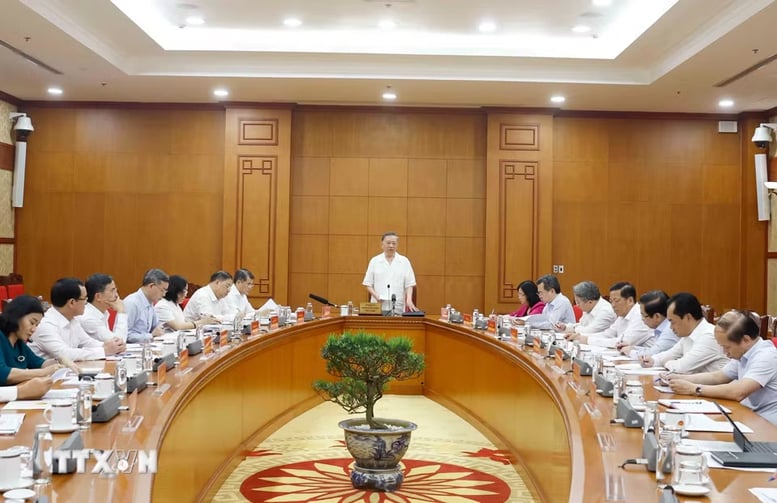
On 19 May 2026, To Lam chaired a working session with the Government Party Committee and several agencies on the implementation of Directive No. 34-CT/TW of the Secretariat and orientations for housing development in the coming period.
The notable innovation in the conclusion lies not only in the requirement to continue developing social housing and ensuring the implementation progress of the Project to build at least one million social housing units, but also in its broader approach: placing the right to lawful housing within the framework of citizens’ fundamental rights. By affirming that access to safe and affordable housing is “a measure of social progress”, this orientation shifts the focus of housing policy from a project-development mindset to a rights-based approach, and from the objective of supplying housing products to the objective of establishing a sustainable foundation for social security.
In recent years, rapid urbanization and the significant movement of labor toward major urban centers, industrial parks, economic zones, and growth regions have increased the demand for safe, stable, and affordable housing. Meanwhile, the housing segment intended for middle-income and low-income groups, workers, and migrant laborers has yet to fully meet actual demand.
The supply of social housing remains insufficient; land designated for social housing development in many areas has not been allocated in a coordinated manner; and numerous projects lack integration with essential technical and social infrastructure, such as schools, healthcare facilities, public transportation, and cultural facilities. Notably, the current housing product structure remains heavily oriented toward homeownership, while the demand for reasonably priced rental housing among workers in major urban centers and industrial parks is substantial.
From a legal and development perspective, this is not merely an issue of supply and demand in the real estate market, but also a matter of equity in access to development opportunities. A worker without stable housing will find it difficult to commit to a long-term relationship with an employer; a young family that cannot access suitable housing will face numerous barriers to wealth accumulation, child-rearing, and participation in urban life; and a city lacking affordable housing will face the risk of residential spatial segregation and the emergence of long-term social pressures.
Therefore, the requirement that “the State shall adopt housing development policies with the aim of ensuring that everyone has a place to live” should be understood as a major policy orientation, associated with the State’s enabling role in safeguarding human rights and citizens’ rights, while at the same time maintaining the healthy and transparent development of the real estate market.
A noteworthy point in General Secretary To Lam’s conclusion is the view that housing development should follow a market mechanism under the State’s effective direction and management. The State does not subsidize housing, but neither does it leave the market to regulate itself entirely. This is a balanced approach, consistent with the requirements of developing a socialist-oriented market economy: respecting market principles, encouraging business participation, while ensuring that such participation operates within the framework of public policy, social interests, and the actual accessibility of housing for the people.
Accordingly, the State plays an enabling role through institutions, planning, land policies, credit policies, investment procedures, construction standards, and transparency control mechanisms. Businesses participate in the construction and operation of housing with reasonable profits. Citizens are provided with access to safe, stable, and affordable housing. If these three stakeholders are connected through an appropriate policy framework, they will create new momentum for the development of social housing and affordable housing.
Rental Housing – A New Direction for Cities, Workers, and Low-Income Groups
One of the breakthrough policy orientations is the requirement that, alongside the development of housing for sale, priority should be given to the development of rental housing, particularly apartment rental models in major urban centers, industrial parks, economic zones, growth regions, and key economic corridors.
This point deserves particular emphasis, as for many years both housing policy and the housing market have remained predominantly ownership-oriented. Meanwhile, for a large segment of the workforce, particularly workers, young employees, newly recruited public officials, and low-income households, immediate homeownership is a goal beyond their financial capacity. Their actual need is, first and foremost, access to stable, safe, and reasonably priced rental housing with adequate connectivity to transportation networks and essential social services.
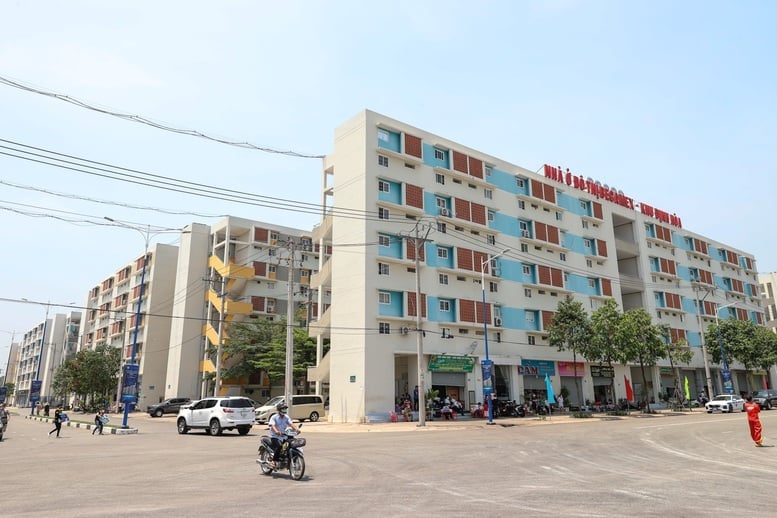
The Dinh Hoa Social Housing Complex in former Binh Duong Province, invested in by Becamex IDC Corporation and inaugurated in 2022, has inspired confidence and enthusiasm among workers through its quality, amenities, and aesthetic design. – Photo: VGP/Nhat Bac
The development of rental housing, therefore, is not merely a temporary solution, but an important component of a modern urban social security policy. If properly designed, this model will help reduce the pressure to purchase homes at all costs, limit the proliferation of unsafe informal rental accommodation, lower living costs for workers, and at the same time enable businesses to retain their workforce in industrial parks and economic zones.
To realize this orientation, the conclusion calls for the development of appropriate land and credit policies; the encouragement of private-sector participation; the establishment of regulations and standards for each housing category; and the simplification of procedures through a one-stop, single-point-of-contact, standardized process mechanism. These are key prerequisites, because if investment procedures remain lengthy, land costs are high, credit incentives are insufficiently attractive, and profit margins are not reasonable, it will be difficult to attract businesses to invest in the affordable rental housing segment.
At the same time, housing planning cannot be separated from urban planning, land-use planning, industrial park planning, public transportation, healthcare, education, cultural development, and population management. A social housing project or rental housing development only truly delivers value when residents not only have a roof over their heads, but also enjoy adequate living conditions and convenient access to employment, schools, hospitals, and essential services.
The conclusion also requires strict and transparent oversight of cases eligible for preferential housing policies, ensuring that such policies are not exploited for personal gain; at the same time, it calls for the monitoring and prevention of housing speculation. This requirement is of direct significance to implementation effectiveness. Even if a policy is sound, its social welfare objectives will be undermined if the approval process lacks transparency, the intended beneficiaries are not properly targeted, or social housing is distorted into a vehicle for speculation.
From the perspective of legal reform, the assignment of the Government Party Committee to study and formulate housing development policies under a new model, conduct a review of Directive No. 34-CT/TW, propose an appropriate document to be issued by the Secretariat or the Politburo, and provide a basis for amending and supplementing the Law on Housing and the Law on Real Estate Business for submission to the National Assembly in 2026 demonstrates that this is not merely a short-term administrative directive, but a profound institutional reform orientation.
Looking more broadly, General Secretary To Lam’s conclusion places housing policy in its proper position: as a pillar of social security, a component of development governance, and a measure of public trust in the State. When the right to lawful housing is recognized as a fundamental right of citizens, housing policy can no longer be confined to questions of how many housing units are built or at what price they are sold; rather, it must answer a broader question: whether people can genuinely access housing that is safe, stable, and consistent with their income and human dignity.
This is also the requirement facing the legal system in the new era: housing development must become more transparent in planning, more convenient in procedures, fairer in the allocation of benefits, more attractive to businesses, and more humane toward citizens. When housing policy is designed on the foundation of citizens’ rights and implemented through effective institutions, each home is not merely a place of residence, but also an anchor of social stability, a driver of sustainable development, and a tangible manifestation of a people-centered enabling State.
(L&D) - On the afternoon of April 1, Standing Deputy Prime Minister Nguyen Hoa Binh, Chairman of the Governing Council of the Vietnam International Financial Center, chaired a meeting with leaders and representatives of several ministries, functional agencies, and the two localities of Ho Chi Minh City and Da Nang to discuss the completion of the draft Regulations on the Operation of the Vietnam International Financial Center.
(L&D) - After the Lunar New Year holiday, workers will enter the Hung Kings’ Commemoration Day holiday, the April 30 – May 1 holiday, and the National Day holiday on September 2 in 2026.
(L&D) - The determination of the value of exhibits and means used in administrative violations (hereinafter referred to as assets) is a crucial step that directly determines the sanctioning authority and the applicable fine bracket. However, current law enforcement practice reveals a lack of consistency between the Law on Handling of Administrative Violations and the 2023 Law on Prices, resulting in legal risks for competent authorities.This article focuses on analyzing these inconsistencies and
(L&D) – Deputy Prime Minister Ho Quoc Dung has just signed a decision approving the 2026 Activity Plan of the Central Council for Coordination in Legal Dissemination and Education, aimed at enhancing the effectiveness of legal dissemination and education, placing citizens and enterprises at the center.
(L&D) - The article analyzes international experience in identifying the risks of legal disputes arising from liquefied natural gas sales and purchase contracts. On that basis, it puts forward several implications aimed at limiting risks in LNG supply activities in Viet Nam.
(L&D) - The determination of the value of exhibits and means used in administrative violations (hereinafter referred to as “assets”) is a key step that directly determines sanctioning competence and the applicable fine bracket. However, current law enforcement practice reveals a lack of consistency between the Law on Handling of Administrative Violations and the Law on Prices 2023, giving rise to legal risks for competent authorities. This article focuses on analyzing and proposing improvements
(L&D) - The Government has just promulgated Decree No. 09/2026/ND-CP prescribing the functions, tasks, powers, and organizational structure of the Ministry of Justice. Accordingly, the Ministry of Justice is assigned an additional task of controlling administrative procedures.
(L&D) - This article analyzes the dual legal nature of traditional lottery tickets, while referencing international experience and proposing an approach grounded in the core principles of civil law in order to improve the legal framework governing this field in Viet Nam.