Davos 2026: A new world order and the ultimate stress test for transatlantic relations
Wednesday, Jan/21/2026 - 13:14
(L&D) - With a hardline agenda and ambitions to restructure global institutions, President Trump is forcing Europe to choose between adapting to the United States or pursuing a risky path of strategic autonomy.
The United States’ ambition to control Greenland has pushed the EU into a state of unease, turning Davos 2026 into the forum that most clearly exposes the strategic rift between Washington and Europe (in the photo: President of the European Commission Ursula von der Leyen, left, during a meeting with U.S. President Donald Trump in Davos in 2020. Photo: AP/TTXVN).
According to the European news outlet Euronews.com, the peaceful Swiss town of Davos is becoming the focus of global attention as this year’s World Economic Forum (WEF) takes place (from 19–23 January) against a backdrop of unprecedented tensions. Unlike previous years, an atmosphere of anxiety is enveloping this resort town as global leaders prepare for a fundamental reassessment of the current international system.
President Trump returns after a six-year absence
The annual meeting of the political and business elite is also taking place at a moment when Europe is facing its greatest-ever challenge regarding its relationship with Washington, its economic model, and its security architecture.
All eyes are on midweek, when U.S. President Donald Trump is expected to make his first appearance at the conference after a six-year absence. His return comes amid escalating tensions stemming from efforts to seize Greenland, threats to impose tariffs on European allies, and military intervention in Venezuela.
On the domestic front, President Trump is expected to announce initiatives to reduce housing costs and to promote the U.S. economic growth model. His major speech on 21 January is likely to focus primarily on domestic issues. According to a White House official, President Trump will unveil “initiatives aimed at reducing housing costs” and “promote his economic agenda, the agenda that has made the United States the world’s leading nation in terms of economic growth.”
However, it is the new foreign policy focus that has left European leaders “on edge.” The White House has sent a clear message: the United States and Europe must put an end to “economic stagnation.” Accompanying this is the threat of imposing heavy tariffs on NATO allies in Europe should they fail to support President Trump’s efforts to gain control of Greenland from Denmark.
On 18 January, European countries including the United Kingdom, Denmark, Finland, France, Germany, the Netherlands, Norway, and Sweden issued a joint statement, noting that actions by the Trump administration related to Greenland risk triggering a “dangerous downward spiral” and undermining transatlantic relations - one of the strongest messages sent to Washington in recent times.
European leaders view the push to gain control of the Arctic island “whether they like it or not” as undermining the foundations of NATO and threatening the long-standing friendship dating back to World War II.
Conflict flashpoints: From Ukraine to Venezuela
Beyond tensions with Europe, there is also the issue of the ongoing war between Russia and Ukraine, which President Trump is keen to bring to an end. Ukrainian President Volodymyr Zelensky, who will also attend the Davos conference in person, hopes to meet President Trump to sign new security commitments for a potential ceasefire agreement with Russia.
The largest-ever U.S. delegation to Davos includes Secretary of State Marco Rubio, Special Envoy Steve Witkoff, and President Trump’s son-in-law Jared Kushner. The presence of Mr. Witkoff and Mr. Kushner - both seen as key figures in any negotiations with Moscow and Kyiv - has led experts to believe that an agreement between President Trump and his counterpart Zelensky will be signed in Davos.
In addition, the future of Venezuela following the United States’ swift military operation to capture President Nicolás Maduro, as well as Washington’s hardline stance toward Iran, are also overarching topics in the discussions.
According to sources, President Trump is also considering convening the first meeting of a “Peace Council” for Gaza in Davos. Hungarian Prime Minister Viktor Orbán has accepted the invitation to participate. Jordan, Greece, Cyprus, Pakistan, Canada, Turkey, Egypt, Paraguay, Argentina, Albania, and India have also indicated that they have received invitations.
Europe's major test
Confronted with a more assertive United States than ever before, Europe finds itself in a strategic dilemma. The continent is not only struggling with weak economic growth and the conflict in Ukraine along its eastern border, but is also facing doubts about its capacity for self-defence in the absence of U.S. security guarantees.
Europe is now under unprecedented pressure: either to accept the new rules of the game set by the Trump administration, or to seek its own risky path toward economic and security autonomy. What unfolds in Davos this week will certainly not be confined to the Swiss resort town, but will reshape the entire regional and global order in the years to come.
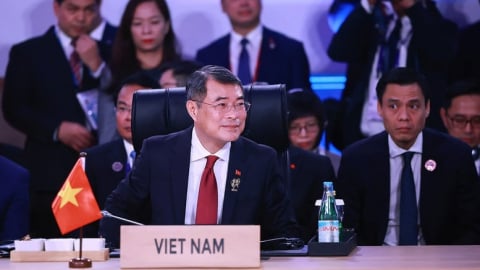
(L&D) - On 8 May, at the Mactan Expo Center in Cebu, the Philippines, Prime Minister Le Minh Hung and a high-level Vietnamese delegation attended the opening ceremony and plenary session of the 48th ASEAN Summit.
(L&D) – After years of focusing on export controls over chips and semiconductor equipment used for Artificial Intelligence (AI), the United States has, for the first time, ordered an AI company to stop providing advanced AI models to foreign nationals on national security grounds. This move has not only sparked debate over the scope of U.S. technology controls but has also raised new questions regarding technological sovereignty, access to AI, and the future of the global AI market.
(PLPT) - After a nearly two-year investigation, the European Union (EU) has imposed a €200 million fine on e-commerce platform Temu for failing to adequately assess and manage risks related to the sale of illegal products on its platform. The case is the latest example of the EU's efforts to strengthen the accountability of digital platforms under the Digital Services Act (DSA).
(L&D) - The European Union has officially adopted new regulations aimed at strengthening water resource protection by adding a number of pollutants to the list of substances subject to stricter monitoring and control, including PFAS - a group of synthetic chemicals that are difficult to decompose and are also known as “forever chemicals” - as well as microplastics and pharmaceuticals.
(L&D) - The ruling invalidating multiple tariffs imposed by President Donald Trump is giving rise to a new form of dispute in the United States: consumers are suing businesses for failing to refund costs allegedly incurred as a result of those tariffs.
(L&D) - The European Union (EU) is considering the possibility of using the “Blocking Statute” to counter U.S. sanctions against the International Criminal Court (ICC), in a context where internal consensus within the bloc has yet to be reached and diplomatic solutions continue to be prioritized.
(L&D) - More than 70 families in Texas are suing SpaceX, blaming Starship rocket launches for having caused vibrations, loud explosions and property damages near the launch site. The lawsuit raises questions about corporate responsibility in the development of commercial space activities in residential areas.
(L&D) - The rapid development of social media platforms is posing multiple consequences for users, especially children, ranging from harmful content to risks of privacy violations. In response to this situation, many countries have begun to tighten regulation over these platforms, establishing clearer requirements regarding responsibility for content control and user protection.