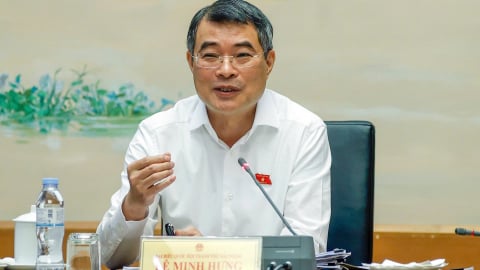
(L&D) - Minister of Education and Training has just issued Circular No. 03/2026/TT-BGDĐT on the Code of Conduct for Teachers in educational institutions within the national education system.
No discrimination of any form among learners
In addition to general codes of conduct, the Circular sets out specific rules of conduct toward learners. Accordingly, it requires teachers to demonstrate exemplary attitudes, compassion, responsibility, and care; to provide feedback, comments, praise or criticism appropriate to the learner and the context; and to encourage and support learners’ efforts and development.
Respect learners and assess their abilities accurately and objectively; safeguard their lawful and legitimate rights and interests; foster motivation to develop their qualities and capacities; listen to them and provide timely guidance and support in academic and social matters in ways appropriate to their age and psychological development.
Teachers are also responsible for creating a safe, positive, and equitable educational environment; encouraging learners to participate in research, productive work, community service activities, and sustainable development.
Notably, the Circular stipulates that teachers must not discriminate against learners in any form; must not insult, harm, persecute, stereotype, commit violence against, or abuse learners in any form, and must promptly report to leaders or competent authorities when detecting that a learner is subjected to violence or abuse; must not coerce learners to participate in activities of a voluntary nature; must not disclose learners’ information in violation of regulations; and must not commit fraud or deliberately falsify results in admissions or learner assessment activities.
Respect, listen to, and support colleagues.
In their conduct toward colleagues, the Circular requires teachers to be honest, sincere, united, cooperative, and willing to share responsibilities and support one another; to engage in self-criticism and peer review in an objective, serious, straightforward, and constructive manner for the advancement of colleagues. They must respect and listen to colleagues’ opinions, coordinate, exchange experience, and learn from one another in professional activities. They must not insult, divide, or undermine internal unity; must not evade or shift responsibility; and must not disclose colleagues’ information in violation of regulations.
Regarding educational institution managers, the Circular stipulates that teachers have the responsibility to comply with the assignments, directions, and management of the institution’s leadership within the scope of their assigned functions and duties; to listen and be receptive to evaluations and feedback from management in professional activities; to actively provide advice and clearly express their professional opinions to managers within their assigned functions and duties; not to insult or undermine internal unity; and not to be indifferent, evade, or conceal any violations committed by the institution’s management.
Teachers have the responsibility to actively promote and spread humanistic values
In interactions with parents or guardians of learners, the Circular stipulates that teachers proactively and promptly provide and share accurate information about the learner, teaching programs, and educational plans, with the consent of the competent management authority. It encourages and facilitates parents or guardians to participate in educational activities for the learner’s progress.
The Circular also stipulates that teachers must not insult, impose, exploit, or coerce parents or guardians into participating in activities that violate State regulations or in activities that are meant to be voluntary.
Regarding interaction with the community, the Circular requires teachers to demonstrate voluntary and proactive participation in social activities; protect the environment; effectively implement and coordinate charitable, humanitarian activities, and initiatives that support the poor and vulnerable groups in society in accordance with the law; and engage in, promote, and spread movements that build a learning society, foster a reading culture, and encourage education and talent development.
Actively promote humanistic values, good deeds, positive images, and culturally appropriate behavior in society and in schools to the community; proactively participate in communication and dissemination about education, and counter false information related to the education sector and teachers on official social media channels; …
This Circular takes effect from January 30, 2026, replacing the provisions in Decision No. 16/2008/QĐ-BGDĐT dated April 16, 2008, of the Minister of Education and Training on the promulgation of Regulations on Teacher Ethics, and Article 6 of Circular No. 06/2019/TT-BGDĐT dated April 12, 2019, of the Minister of Education and Training stipulating the Code of Conduct in preschool education institutions, general education institutions, and continuing education institutions.
(L&D) - The proposal to raise the tax threshold to VND 1 billion per year clearly reflects the requirement to provide support to the right target groups, ensure fairness, and prevent revenue loss.
(L&D) - The National Assembly has decided to abolish the fixed taxable revenue threshold of 500 million VND/year, delegating to the Government the authority to set an appropriate threshold, with an expected increase to 1 billion VND/year. This is not merely a technical tax adjustment, but also a major reform step aimed at supporting the household economy to develop legitimately, transparently, and sustainably.
(L&D) - After 8 years of implementation, the Project on integrating human rights content into the national education curriculum has created a clear transformation in awareness of the rule of law, contributing to affirming Viet Nam’s consistent policy of respecting, protecting, and ensuring human rights.
(L&D) - May 2026 sees many new policies taking effect, notably: Implementation of regulations on participation in supplementary pension insurance from May 10, 2026; from May 15, 2026, users of e-cigarettes face fines of up to 5 million VND...
(L&D) - On the afternoon of April 7, after being elected by the 16th National Assembly as Prime Minister of the Government for the 2026–2031 term, Comrade Le Minh Hung took the oath of office and delivered his inaugural address before the National Assembly and compatriots and voters nationwide. The Government Portal respectfully introduces the full text of the inaugural address by Prime Minister Le Minh Hung.
(L&D) - Delegate Dang Ngoc Huy, Member of the National Assembly Delegation of Quang Ngai Province, proposed the early development of an independent national petroleum reserve system to overcome strategic delay, ensure energy security, and maintain the foundation of macroeconomic stability.
(L&D) - At the 1st Session of the 16th National Assembly, economic development orientations were placed along the axis of institutional development, high growth, macroeconomic stability, and national self-reliance.
(L&D) - With 100% of the attending deputies in favor, the National Assembly voted to adopt resolutions approving the appointment of 6 Deputy Prime Ministers, Ministers, and members of the Government for the 2026–2031 term.